.jpg)
College of Agriculture · Department
Agrometeorology
Established in 2000 — encouraging weather-responsive farming through the Gramin Krishi Mausam Sewa (GKMS), with research in remote sensing, GIS and climate-resilient agriculture.
Established in 2000 — encouraging weather-responsive farming through the Gramin Krishi Mausam Sewa (GKMS), with research in remote sensing, GIS and climate-resilient agriculture.
The primary objective of the department is to help the farmers in their farming and encourage weather-responsive farming in Uttarakhand to achieve maximum production, utilization of resources and protect the natural environment from various weather hazards at the same time; through Agromet advisory services provided by Gramin Krishi Mausam Sewa (GKMS).
Considering the significance of weather and climate and their influence on crop growth, development and yields, department of Agrometeorology came in to existence in the year 2000 after the bifurcation of department of Soil Science. Until the inception of department, teaching, research and extension activities pertaining to Agrometeorology was carried out within the Department of Soil Science. The M.Sc. Programme in Agrometeorology was initiated in 1995, while Ph.D. programme started in 2000. Research thrust in Agrometeorology includes climatic characterization of hill and plain zones of Uttarakhand, crop-weather relationships, application of weather driven dynamic crop growth and yield simulation models, weather-crop-insects/disease interactions, climate change and its effects on crop productivity, evapotranspiration, suitability analysis using Remote Sensing and GIS etc.
Department is imparting education to UG, PG and Ph.D. students related to application of meteorology in Agriculture. Department is continuously taking up research projects related to Agrometeorology, Weather forecasting, Remote Sensing and GIS for devising the methodologies/techniques for sustainable Agriculture production and precision crop management. The main aim of Agromet advisory services (AAS) under GKMS is to gather information on weather and climate, soil related information, and crop-based knowledge and combines them with weather forecast in order to provide farmers the vision to manage their decision, which ultimately would bring maximum productivity with minimum loss.
| S.No. | MoU Signed | Date |
|---|---|---|
| 1. | MoU Signed between GB Pant University and NABARD | 24.09.2019 |
| 2. | MoU Signed between GB Pant University and Uttarakhand Space Applications Centre, Dehradun, Uttarakhand | 08.05.2013 |
| 3. | MoU Signed between GB Pant University and NESAC, Umiam, Meghalaya | 13.09.2019 |
| 4. | MoU Signed between GB Pant University and ISRO | 24.08.2019 |
| 5. | MoU Signed between GB Pant University and IMD, New Delhi | 04.02.2021 |
| S. No. | Degree | No. of Seats | Total | ||
|---|---|---|---|---|---|
| Uttarakhand domicile | Other State | ICAR | |||
| 1. | M.Sc. Ag. Agrometeorology | 03 | - | 02 | 05 |
| 2. | Ph.D. Agrometeorology | 01 | 02 | 02 | 05 |
GHG Lab with IRGA and GC
Each profile carries the faculty member’s qualifications, research interests and publications.
The department’s detailed research profile is available in the document below.
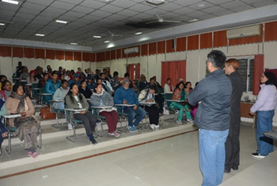
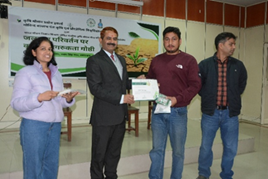
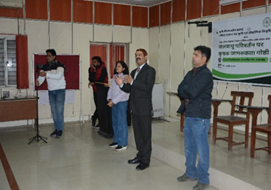
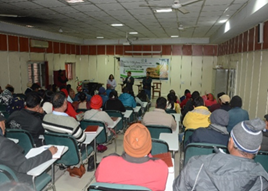
A one-day Farmer Awareness Program on the impact of climate change on agriculture was organized on 31 January 2026 by AMFU, Pantnagar at Govind Ballabh Pant University of Agriculture and Technology for farmers of Uttarakhand. Around 100 farmers participated in the programme. The session was led by Dr. A.S. Nain, Principal Nodal Officer of the GKMS project, who addressed the key farming challenges arising from climate change and emphasized appropriate mitigation and adaptation strategies. He sensitized farmers to the recommended agricultural practices to manage ground frost during the winter season and heat stress/heat wave conditions during the summer season. The programme was actively supported by Dr. Shivani Kothiyal (Technical Officer) and Mr. Jabir Khan (Agromet Observer), who assisted in organizing the event and distributing certificates. The University staff, Dr. Chetan Bhatt (SMS, Pithoragarh) also participated in the programme. Farmers were provided with Trichoderma packets prepared at the University’s Biocontrol Centre, along with vegetable seeds developed by the Vegetable Research Centre.